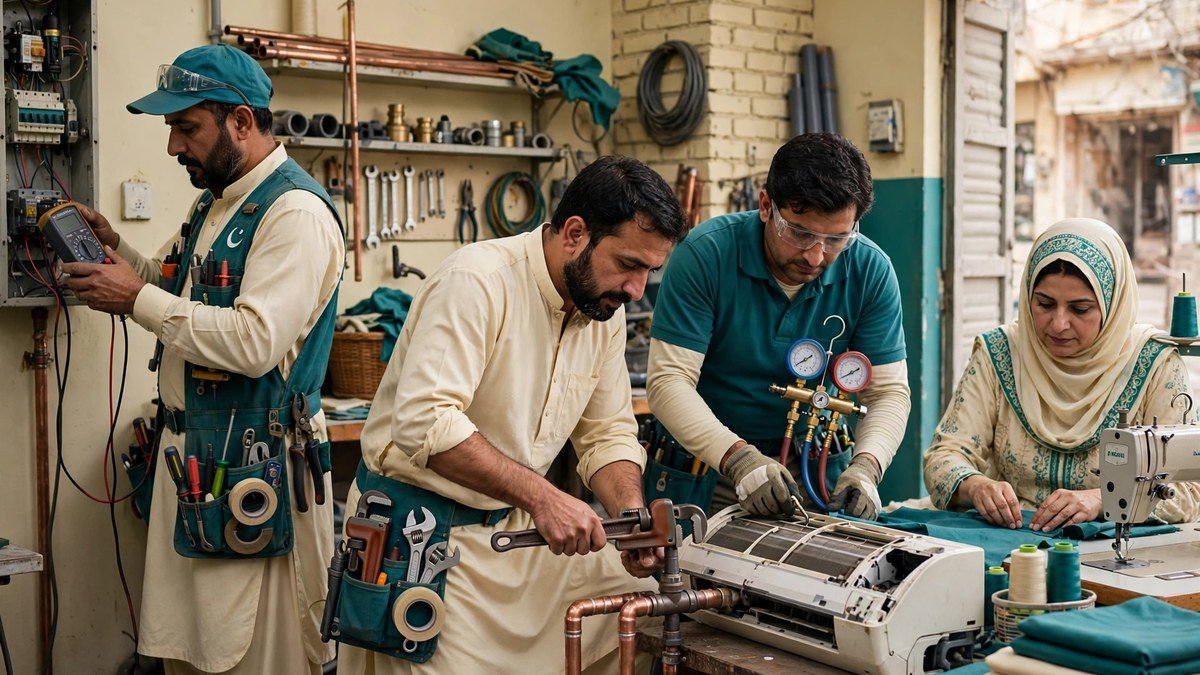
Every year, thousands of young Pakistanis face the same question: which skill should I learn? University is not the only route to a respectable living — and for many families, it is not the fastest one either. A good electrician, plumber, AC technician or tailor can earn steadily, work independently, and build a name in their own city. But the four trades are genuinely different: one rewards careful technical thinking, another rewards physical stamina, a third is seasonal, and the fourth rewards design sense and patience. Choosing the wrong one for your temperament wastes a year. This guide compares all four on the things that actually matter, so you can pick the one that fits you.
First, the honest truth about all four trades
No trade guarantees an income, and anyone who promises one — an institute selling a course, an agent selling a job abroad — should be treated with suspicion. What a trade gives you is a marketable ability: people always need wiring fixed, pipes repaired, ACs serviced and clothes stitched. Your earnings then depend on your skill level, your city, your reliability, and how well customers can find you. The workers who earn best in every trade share the same habits: they arrive on time, quote clearly, finish neatly, and keep customers for years. Keep that in mind as you read the comparisons — the trade opens the door, but your habits decide how far you go.
Electrician: steady work, real responsibility
What the work is: house wiring, switchboards and breakers, fans and lights, inverters and UPS systems, and increasingly solar-related wiring. Learning time: basic paid work often comes within 3–6 months of supervised practice; confident independent work, including full house wiring, usually takes 1–2 years. Startup cost: moderate — a good toolkit, tester, drill and safety gear; no shop required at the start. Demand: steady all year, in every city and town, because every building has wiring that ages and fails. Risks: real ones — electric shock and falls. Safety discipline is not optional in this trade. Suits you if: you are careful, methodical, comfortable with basic maths and diagrams, and willing to keep learning as systems change.
The electrician's advantage is breadth: the same skill serves homes, shops, offices and small factories, and experienced electricians can specialise further into solar installation or industrial work. The disadvantage is responsibility — a wiring mistake can cause a fire, so customers (rightly) judge you harshly, and your reputation is built slowly and lost quickly.
Plumber: work in every street, all year round
What the work is: bathroom and kitchen fittings, pipe installation and leakage repair, water motors and tanks, drain clearing. Learning time: basic jobs within 3–6 months of working with an experienced plumber; concealed piping and full bathroom work take longer. Startup cost: low to moderate — hand tools, pipe tools and a few power tools. Demand: constant everywhere; pipes leak in every season and every city. Risks: lower than electrical work, but wet floors, heavy lifting and occasional work in confined spaces still demand care. Suits you if: you are physically strong, practical, unbothered by messy work, and good at talking to customers in their homes.
Plumbing's strength is its universality: unlike AC work it has no off-season, and unlike tailoring it does not depend on fashion. Its weakness is that emergency calls — burst pipes, blocked drains — often come at awkward hours, and concealed-leak jobs can turn into long, dusty days. Plumbers who explain charges clearly and clean up properly build the strongest repeat customer base of any trade.
AC technician: seasonal peaks, technical pay
What the work is: split and window AC installation, general service, gas refilling and fault diagnosis, plus refrigerator work for many technicians. Learning time: basic service work within a few months of training; confident installation and diagnosis usually takes 6–12 months of supervised jobs. Startup cost: higher than the other trades — gauges, vacuum pump, recovery tools and transport for outdoor units add up. Demand: intensely seasonal: summer brings a flood of installation and service calls, winter brings very little, so smart technicians save in summer and diversify (for example into refrigerator or electrical work) for winter. Risks: work at height on outdoor units, refrigerant handling, and electrical supply to the unit. Suits you if: you like technical diagnosis, can handle summer pressure, and are comfortable planning your income across seasons.
The AC technician's advantage is per-job value: installation and gas work pay more per visit than most small electrical or plumbing jobs. The disadvantage is the season: a technician who spends everything in July will struggle in January. If you choose this trade, plan winter income from day one.
Tailor: skill, patience and a shop of your own
What the work is: measuring, cutting and stitching shalwar kameez, suits, ladies' garments and alterations. Learning time: basic stitching within 3–6 months; good cutting and fitting — the skills customers actually pay for — take 1–3 years of practice. Startup cost: a sewing machine and basic tools to start from home; a shop adds rent but also walk-in customers. Demand: strong and seasonal in a different way: steady alterations all year, with big peaks before Eid and during wedding season, when skilled tailors are booked weeks ahead. Risks: the lowest physical risk of the four, but the highest reputation risk from a single bad fitting — one ruined suit loses a customer permanently. Suits you if: you are patient, detail-obsessed, good with people's preferences, and happy working seated for long hours.
Tailoring's unique advantage is that it can start from home with almost no overhead, and it suits women workers as well as men — an important point in a country where home-based work opens doors for many. Its disadvantage is price pressure: cheap ready-made clothing competes hard, so a tailor must win on fitting and finishing, not on price alone.
The side-by-side comparison
- Fastest to first paid work: plumbing and basic electrical jobs, then tailoring basics, then AC service work.
- Lowest startup cost: tailoring from home, then plumbing, then electrical, then AC work.
- Steadiest all-year demand: plumbing and electrical, then tailoring, then AC work (strongly seasonal).
- Highest per-job value: AC installation and full house wiring, then bathroom work, then design tailoring.
- Most physical risk: electrical work, then AC work at height, then plumbing, then tailoring.
- Best for working from home: tailoring, then small electrical and plumbing jobs run from a phone number.
How to learn: institute, ustad, or both
Pakistan offers two honest learning routes, and the best workers often combine them. The ustad-shagird route — starting as a helper with an experienced worker — teaches real speed, customer handling and site sense, and usually pays a small amount while you learn. Its weakness is gaps: an ustad may never teach theory, safety standards or new systems. The institute route — TEVTA institutes, NAVTTC programmes and private technical institutes — adds theory, safety training and a certificate, which matters for formal jobs and for work abroad. Its weakness is limited real-job practice. The practical combination: a short institute course for foundations and safety, plus a year working under a good ustad for real skill. Whichever route you take, never pay an institute or agent who guarantees a job or a visa — training is real, guarantees are fraud.
Choose with this five-question test
- What work can you do happily for ten hours? If sitting and stitching bores you, tailoring will fail no matter how good the market. If heights frighten you, AC outdoor work is a bad fit.
- What can you afford to start? A trade with high tool costs needs savings or family support; a home-based trade needs almost none.
- What does your city need? A small town may already have five electricians and no good AC technician — or the reverse. Ask shopkeepers and neighbours before deciding.
- Can you handle the season? AC work means feast and famine; tailoring means Eid rushes. Pick the rhythm you can live with.
- Who will teach you? A trade with a good ustad or institute nearby beats a "better" trade with nobody to learn from.
And remember: choosing one trade does not imprison you. Many workers start in one trade and add a neighbouring one later — electricians who learn solar, plumbers who learn fitting sales, tailors who learn design. Start with one, learn it properly, earn a name, and then expand.
Frequently asked questions
Which trade earns the most in Pakistan?
There is no single answer: earnings depend on your city, your skill level, your reputation and how many customers you serve. Electricians and AC technicians often earn well in big cities, plumbers earn steadily everywhere, and tailors with strong design skills earn well before Eid and wedding seasons. No trade guarantees an income — skill plus reliability is what pays.
Can I learn a trade without joining an institute?
Yes. The traditional ustad-shagird route — working as a helper with an experienced worker — still teaches most of the practical skill. Institutes like TEVTA and NAVTTC programmes add theory, safety training and a certificate, which helps with formal jobs and overseas applications. Many successful workers combine both.
How long does it take to become employable in a trade?
For basic paid work, most learners need roughly 3 to 12 months depending on the trade: tailoring basics and simple electrical or plumbing jobs come faster, while AC installation and full house wiring take longer. Real confidence comes from supervised practice on real jobs, not from course length alone.
Is it too late to learn a trade at 30 or 40?
No. Trades reward reliability and finished work, not age. Many people switch to a trade in their thirties after other work dries up, and customers care about the quality of the job, not the age of the worker. Start with one trade, learn it properly, and build from there.
Your next step
This week, visit two workers in the trade you are leaning toward and ask them what a normal day looks like — the honest version, not the sales version. Then look at the Skilled Workers directory to see how workers in each trade present their services and areas, and if you already have a skill, complete your Worker profile so customers in your city can find you. Keep an eye on today's jobs too — many employers hire helpers and trainees, which is how most trade careers actually begin. ہنر سیکھنا مشکل نہیں، فیصلہ کرنا مشکل ہے — ایک بار فیصلہ کر لیں، پھر محنت خود راستہ بنا دیتی ہے۔