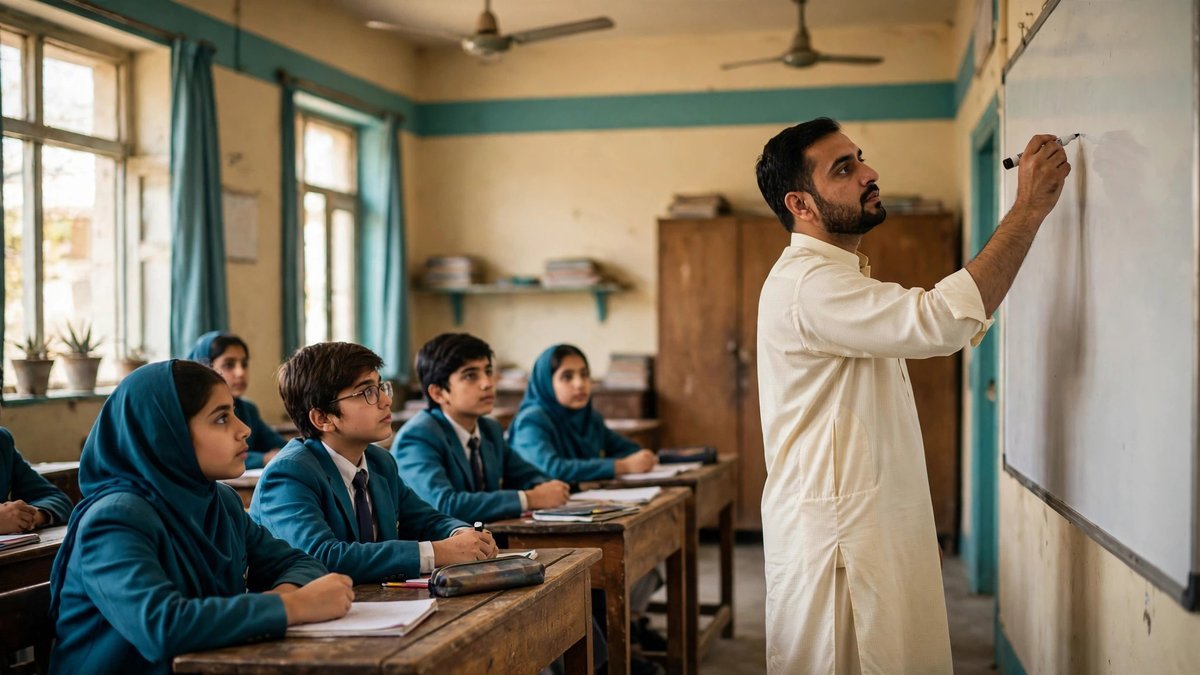
For thousands of graduates in Pakistan, the first job they picture is a teacher's chair: a government school, a regular salary, respect in the community, and a career that does not disappear with the next contract. Every year, provincial education departments announce teaching posts — and every year, good candidates are rejected for reasons that have nothing to do with ability. They applied for the wrong post, missed the district rule, prepared for the wrong test, or paid an agent who promised them a seat that was never for sale. This guide covers the honest version: who hires teachers and for which posts, who can apply, what the test usually looks like, a 30-day preparation plan you can actually follow, and the fraud signs that should make you walk away.
Who hires teachers, and for what posts
Teaching jobs in Pakistan are announced by the provincial School Education Departments — Punjab, Sindh, Khyber Pakhtunkhwa and Balochistan — and by the Federal Directorate of Education for schools in Islamabad. Each province runs its own recruitment, with its own advertisement, its own posts and its own test. There is no single national teacher recruitment, so a candidate in Lahore and a candidate in Peshawar are applying through different systems, even when the post names sound the same. The post names you will see most often are:
- PST — Primary School Teacher: teaches primary classes. The entry post in most provinces, and the one with the largest number of seats in a typical recruitment.
- EST — Elementary School Teacher: teaches middle (elementary) classes, often in a subject. A step above PST in level and usually in qualification.
- SST — Secondary School Teacher: teaches secondary classes in a named subject — English, Maths, Science, Urdu, Islamiat, Computer Science and others. Your degree must match the subject.
- JEST — Junior Elementary School Teacher: the Sindh name for a similar elementary post, recruited by the Sindh education department.
- Subject specialists, headmasters and headmistresses: advertised separately, usually with higher qualification and experience requirements.
Two practical points. First, the post name decides the test: a PST paper leans on general knowledge and pedagogy, while an SST (Science) paper tests the subject itself. Apply for the post your degree actually matches — a general BA does not make you an SST (Maths) candidate. Second, many educator recruitments are contract-based at first, with regularisation under provincial policy. The advertisement states the terms; read it before you apply, not after you are selected.
Who can apply: the eligibility basics
Every advertisement is different, but the pattern is consistent. Check these five things before you spend a rupee on preparation:
- Degree: a bachelor's degree (14 or 16 years of education) from a university recognised by HEC is the usual minimum. For SST posts, the degree must usually be in the relevant subject.
- Teaching qualification: a B.Ed or M.Ed is not always compulsory, but it usually earns merit marks and is sometimes required for specific posts. If you have one, it helps; if you do not, check the advertisement — do not assume.
- Age: each province and post sets its own maximum age, with relaxations sometimes allowed for specified categories. There is no single national age limit for teachers, so confirm it in the current advertisement.
- Domicile: teaching posts are usually filled by district. Your domicile decides which district's merit list you are on — apply for the district your domicile belongs to, and keep your CNIC and domicile certificate ready and matching.
- Merit and documents: selection is usually by merit — academic marks, test score, and sometimes an interview or demo lesson, weighted as the advertisement states. Keep attested copies of every document ready; a missing certificate at verification time can end a selection.
Where teaching jobs are announced
Teaching vacancies appear in three places: the provincial education department's own website and notice board, leading newspapers, and the testing service's website when a test is involved. Treat every other source with suspicion — especially social media posts and WhatsApp forwards that quote a salary, a deadline and a phone number but link to no official page. A genuine advertisement always names the department, the post, the eligibility, the last date, and the exact place to apply. If any of those are missing, it is not worth your time — or your money.
Keep a simple habit: check your province's education department announcements once a week, and check our Jobs page daily — fresh teaching and government openings are listed there as they are announced through official channels. And before you apply to anything, read our guide to reading a government job advertisement — it explains every line of an ad, from eligibility and domicile to age relaxation and fees. How to read a government job ad in Pakistan.
The test: what it usually looks like
The test is the first real gate, and its shape depends on the province and the post. The advertisement names the testing service — in Punjab this has often been the Punjab Public Service Commission or the National Testing Service; in Sindh the SIBA Testing Service; in Khyber Pakhtunkhwa ETEA. Whatever the service, the paper usually mixes the same ingredients:
- Subject knowledge: for SST posts, questions from the subject itself — a Maths teacher is tested on Maths, not on general knowledge alone. For PST and EST posts, the subject share is smaller and general content is larger.
- Pedagogy and teaching methods: how children learn, classroom management, lesson planning, assessment — the section candidates with no B.Ed find hardest, and the one that separates teachers from graduates.
- English: vocabulary, grammar, sentence correction and short comprehension passages.
- General knowledge and current affairs: Pakistan and world affairs, Islamiat, Pakistan Studies and everyday science.
- Analytical and IQ: number and letter series, analogies and basic reasoning — a smaller share than in bank tests, but it still appears.
Two things to know about scoring. First, some papers carry negative marking and some do not — the advertisement or the test instructions say so; never assume. Second, the test is not the whole selection. Candidates who clear it are usually called for document verification and then an interview or a demo lesson, and the final merit list weighs academics, test and interview together. A brilliant test score with a failed verification rarely survives.
A realistic 30-day preparation plan
This plan assumes you can give two to three focused hours a day. If you have less time, stretch it to six weeks rather than cutting corners — a rushed plan that skips mock tests is worse than a slower one that includes them.
- Days 1–3 — map the paper. Find the test pattern for the post and province you are targeting: sections, number of questions, time allowed, and whether there is negative marking. Collect two or three past papers or sample papers from the testing service's website. Buy or borrow one standard MCQ preparation book for your subject — one good book used fully beats five half-read ones.
- Days 4–10 — rebuild the subject. Revise your own subject from your degree textbooks, one topic a day, with 20 practice questions each. If you are applying for an SST post, this is the section that decides your result — do not spend this week on general knowledge instead.
- Days 11–17 — pedagogy and English. Study teaching methods daily: learning theories in plain words, classroom management, lesson planning, assessment types. Thirty pedagogy questions a day is enough to build the vocabulary. English alongside: 30 new words a day, one grammar topic a day, one short passage.
- Days 18–24 — timed sections and general knowledge. Start doing whole sections against the clock. Keep a small notebook of every question type you keep getting wrong — that notebook, not a new book, is your real syllabus for the last week. One hour a day on general knowledge and current affairs, from a daily newspaper.
- Days 25–28 — full mock tests. Sit two full papers under real conditions: same time of day as the real test, no phone, no breaks, answer sheet and all. Score them, study every wrong answer, and practise the negative-marking rule if your paper has one: attempt what you are reasonably sure of, skip what you are guessing at.
- Days 29–30 — taper. Revise your mistake notebook, re-read your vocabulary list, prepare your documents folder for verification day, and rest. The night before the test, sleep properly — a tired candidate makes the easy mistakes, and easy mistakes are the ones that cost seats.
The interview and demo lesson: what they actually check
Teacher interviews are different from office interviews: the panel is not only checking what you know, but whether you can teach it. Expect questions about why you chose teaching, the subject you applied for, and how you would handle a real classroom — a weak student, a noisy class, a parent's complaint. Some selections include a short demo lesson: you teach a topic for ten or fifteen minutes while the panel watches. Prepare one honest demo lesson in advance — a simple topic from your subject, a clear start, one activity, and a short summary — and practise it out loud, on your feet, with a timer.
On the day, dress the way teachers dress: clean, pressed, modest — a neat shalwar kameez for men, a modest formal outfit for women. Arrive early, carry your original documents and attested copies in a proper folder, keep your phone silent, and answer in your own words. If you do not know something, say so plainly and move on — panels forgive an honest "I don't know" far more easily than a confident wrong answer. Our Prepare section has daily practice sets for MCQ tests, including the general-knowledge and English sections that appear in educator papers.
Five mistakes that cost teaching jobs
- Paying an agent. The most expensive mistake. Genuine teacher recruitment is free, public and advertised. Money paid to an agent buys nothing but a story.
- Applying for the wrong post. A general degree does not qualify you for a subject-specific SST post, and a PST application does not become an EST one. A rejected application costs the whole cycle.
- Preparing for the wrong test. Each province and post has its own pattern. Practising bank-test maths for a pedagogy-heavy PST paper wastes your month. Always start from the pattern of the post you are actually applying for.
- Ignoring pedagogy. Many strong graduates fail on the teaching-methods section — the one section that actually tests whether you can teach. Give it a full week, not a single evening.
- A careless application. A wrong district, a wrong domicile, a phone number that does not work, or documents that do not match will end the process before the test begins. Read our guide to reading a government job advertisement before you submit, and double-check every field against your documents.
Frequently asked questions
Do I need a B.Ed to become a government school teacher in Pakistan?
Not always. Many PST and EST advertisements accept a bachelor's degree without a B.Ed, though a B.Ed or M.Ed usually earns merit marks and is sometimes required for specific posts. Read the current advertisement: it states the requirement plainly. If you plan to teach long-term, a B.Ed is still worth doing — it teaches the pedagogy section that decides many papers.
What is the difference between PST, EST and SST posts?
The level you teach. PSTs teach primary classes, ESTs teach elementary (middle) classes — often in a subject — and SSTs teach secondary classes in a named subject such as English, Maths or Science. The higher the level, the more the test weighs your subject knowledge, and the higher the qualification the advertisement usually asks for. Sindh uses JEST for a similar elementary post.
Is the educators' test the same in every province?
No. Each province runs its own recruitment with its own testing service and pattern — Punjab has used the PPSC and NTS, Sindh the SIBA Testing Service, Khyber Pakhtunkhwa ETEA. The subjects are similar — subject knowledge, pedagogy, English and general knowledge — but the weight of each section differs, so prepare from the pattern of the province and post you are actually applying for.
Can I apply for a teaching job in another district or province?
Usually only through your own domicile. Teaching posts are filled by district, and your domicile decides which district's merit list you are on. Some posts allow applications from anywhere in the province, and a few federal posts are open nationally — but the advertisement states the rule. Applying outside your domicile district is the most common reason applications are rejected at verification.
Your next step
Start this week: pick the post your degree matches, find the last advertisement for it, and begin the 30-day plan above with your subject and pedagogy. While you prepare, keep your applications moving — fresh teaching and government openings are listed daily on our Jobs page, and our Prepare section has daily practice sets for MCQ tests. Complete your Job Seeker profile so employers and recruiters can find you too. استاد بننا صرف نوکری نہیں، ذمہ داری ہے — تیاری اور درست راستہ ہی اصل کنجی ہے۔ اللہ آپ کو کامیابی دے۔